
Is My Pine Tree Dead, Dying or Just Dormant?
A pine tree with some yellow or brown needles is not necessarily dying. Older interior needles commonly change color and fall while newer outer needles remain green. However, widespread browning, dying branch tips, or major trunk and root damage should not be dismissed as winter dormancy.
For homeowners in Winston-Salem, Clemmons, Lewisville and surrounding Forsyth County communities, the first useful question is: Where is the color changing?
A scattering of older needles inside the canopy means something different from an entire crown turning brown. Here is how to recognize the difference and decide what to do next.
Is My Pine Tree Dead or Just Dormant?
Pine trees are evergreen. Their growth slows seasonally, but they normally retain living green needles through winter. Dormancy does not cause a healthy pine to turn completely brown or lose its entire canopy.
That makes pines different from deciduous trees, which naturally drop their leaves and stand bare through winter.
Loblolly pine and Virginia pine are both North Carolina natives found in the Piedmont. Their appearance and growing needs differ, so identifying your pine is useful before drawing conclusions about its health. North Carolina Extension Gardener Plant Toolbox
Rather than assuming a brown pine is “sleeping,” look at the pattern of discoloration and whether branches, buds and newer needles remain healthy.
Do Pine Trees Lose Their Needles in the Fall?
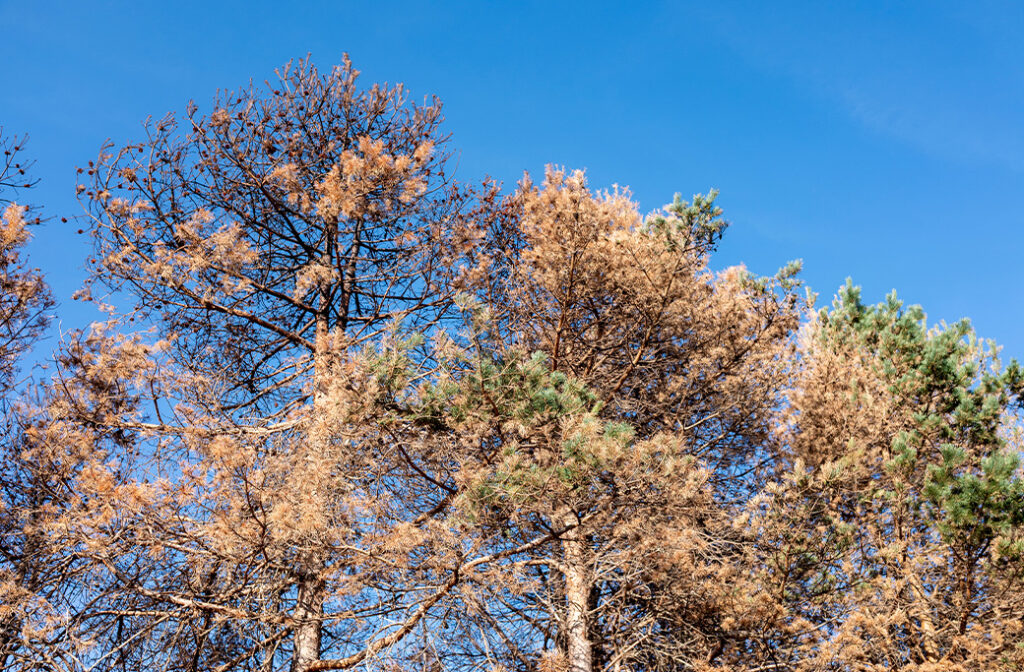
Widespread browning deserves closer evaluation rather than being dismissed as dormancy.
Yes. Pine trees shed older needles even though they are evergreen. Evergreen means they retain foliage year-round, not that each needle lasts forever.
Normal seasonal shedding usually affects older needles farther inside the canopy. These needles may turn yellow, then brown, before falling. Newer needles toward the branch ends remain green.
The amount and timing vary by species. Previous weather stress can also make seasonal shedding more noticeable. Yard and Garden
During fall yard cleanup, take a moment to look up before worrying about the pine straw below. The pattern in the branches tells you more than the amount on the ground.
Normal Needle Shedding Versus Warning Signs
| What You Notice | More Consistent With Seasonal Shedding | Worth Further Evaluation |
|---|---|---|
| Location of discoloration | Older needles inside the canopy | Newer needles or entire branch ends turning brown |
| Outer foliage | Remains mostly green | Becomes discolored or sparse |
| Pattern | Older needle groups changing together | Whole branches, the top, or large canopy sections declining |
| Progression | Older needles fall while green foliage remains | Browning continues to spread |
| Other symptoms | No obvious damage accompanying the shedding | Broken limbs, trunk wounds, unusual resin or root movement |
This comparison is a starting point, not a diagnosis. Seasonal shedding and a separate tree-health problem can occur at the same time. University of Minnesota Extension distinguishes normal fall needle loss from several pest and disease patterns.
How Can You Tell If a Pine Tree Is Dying?
Look for several symptoms together, especially changes that affect newer growth or continue spreading.
Signs worth investigating include:
-
- Browning across much of the crown.
- Dead branch tips or an increasingly sparse canopy.
- Entire branches dying rather than older needles shedding.
- Unusual resin deposits accompanied by holes or boring dust.
- Major trunk wounds, cracks or damaged roots.
- Fungal growth attached to the trunk or root flare.
- A new lean or soil lifting around the tree’s base.
Color alone does not identify the cause. Site conditions, recent construction, weather and the location of damage all matter. NC State Extension recommends evaluating those factors together when investigating plant decline.
Can You Tell By Scratching the Bark?
A small bark check may reveal whether tissue at that particular location is alive. It does not establish the condition of the whole tree or whether the tree is structurally sound.
You do not need to cut into your pine’s trunk to begin evaluating it. Take photographs from a safe distance and note when the changes appeared. Avoid climbing or pulling on dead branches.
Why Is My Pine Tree Turning Brown?
Several problems can produce similar-looking symptoms.
Normal Seasonal Needle Drop
Older interior needles may discolor and fall as part of the tree’s normal cycle. Green outer foliage is an encouraging sign, although it does not rule out every problem.
Drought and Heat Stress
A prolonged dry period can limit the moisture available to roots. Heat can add to that stress.
Consider whether the tree has experienced an extended dry spell and whether the soil is actually dry before adding water. Our guide to watering trees during a North Carolina summer explains the factors that affect watering needs.
For a broader look at symptoms and care, read identifying and treating tree heat stress.
Too Much Water or Root Damage
More water is not always the answer. Saturated soil can deprive roots of oxygen. Trenching, construction and soil compaction can also interfere with root function.
Review what has changed around the tree, including irrigation, drainage, digging and vehicle traffic. These details can help distinguish a site problem from an insect or disease issue.
Insects or Disease
Pines can develop insect and disease problems that damage needles, shoots or other tissues.
Some symptoms overlap with environmental stress. Photograph unusual spots, affected shoots, insect activity or resin deposits, but avoid choosing a treatment from needle color alone. NC State’s conifer-pest guidance documents several different pests and injury patterns.
Storm or Mechanical Damage
Broken branches, trunk injuries and damaged roots deserve attention even if much of the canopy remains green. A tree’s appearance and its structural condition are related, but they are not interchangeable.
Can a Brown Pine Tree Turn Green Again?
Needles that have died will not become green again. A living pine may continue growing if enough healthy tissue remains and the underlying problem can be corrected.
Recovery therefore depends on what has been damaged. Losing older interior needles is different from losing newer growth across the entire crown.
Water and fertilizer cannot revive a dead tree. If most of the canopy is brown, arrange an evaluation rather than waiting for spring to provide the answer.
How Can You Help a Stressed Pine Tree?
Start with the growing conditions before reaching for a product.
Check Soil Moisture Before Watering
Check beneath the surface in several accessible locations without cutting roots. If the soil is dry, water slowly enough to soak into the root zone. If it is already wet or waterlogged, additional irrigation can make matters worse.
Watering needs vary with tree size, soil, drainage, weather and planting age. A fixed daily schedule is not appropriate for every pine.
Mulch Without Burying the Trunk
Maintain approximately 2–3 inches of mulch, accounting for the material already present. Keep it about 6 inches away from the trunk.
Mulch can conserve moisture and moderate soil temperature. Excessive mulch or mulch against the trunk can create problems, and poorly drained sites need particular care.
Protect the Root Zone
Keep vehicles, stored materials and digging away from the roots. Avoid adding soil around the trunk or changing the grade without professional guidance.
Avoid Heavy Pruning and Guesswork Treatments
Do not remove healthy green branches simply because older interior needles are shedding.
Where dead or damaged limbs need attention, our tree pruning services can help address practical pruning needs.
Avoid applying fertilizer, pesticides or fungicides without identifying a reason for treatment. A product cannot correct every cause of browning.
When Should a Dying Pine Tree Be Removed?
Removal may be appropriate when a pine is dead, has serious structural damage, or presents a risk that cannot reasonably be managed through other work.
Arrange prompt professional attention when you notice:
-
- Large dead or hanging limbs.
- Major trunk cracks.
- Recent root movement or a new lean.
- Extensive canopy death.
- Significant damage near a home, driveway, play area or frequently used space.
Keep people and pets clear of visibly unstable trees or hanging branches. Do not attempt to remove large limbs yourself.
Brown needles alone do not make removal necessary. The tree’s condition, location and practical care options should guide the decision.
Our article on what happens if you leave a dead tree standing explains what to consider once a tree has been confirmed dead.
When Should You Call Shannon & Sons?
If your pine has widespread browning, major dead limbs or visible structural damage, we can help you discuss appropriate tree-care, pruning or removal work.
At Shannon & Sons Tree Service, we serve homeowners throughout Winston-Salem and the surrounding Triad. Tell us what has changed, when you first noticed it and whether recent storms or work around the roots may be involved.
Not sure what your pine needs? Call 336-244-2633 to discuss the next step, or learn about our tree removal services. We’ll help you understand the work involved if removal is appropriate.