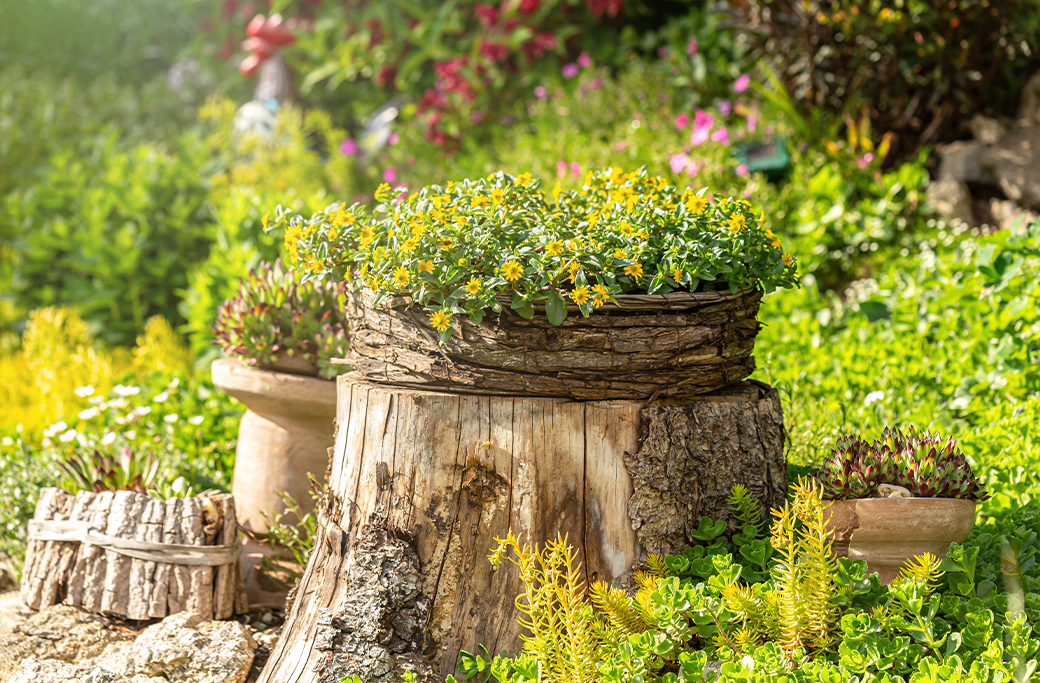
A leftover tree stump can interrupt an otherwise attractive front yard, planting bed, or lawn. However, if the stump is in a low-traffic location and remains reasonably solid, you may not need to remove it immediately. Plants, containers, mulch, and carefully chosen garden features can help it blend into the landscape.
Before decorating around it, take a closer look at its location and condition. A stump that creates a tripping hazard, interferes with mowing, produces persistent sprouts, or shows extensive decay may be a better candidate for professional grinding.
How Can You Hide a Tree Stump in Your Yard?
The easiest ways to hide a tree stump are to create a flower or mulch bed around it, arrange container plants nearby, turn a sound stump into a planter, or incorporate it into a woodland-style garden. Avoid burying the stump under deep soil or placing heavy objects on decaying wood. If the stump is unstable, inconvenient, or located in a frequently used area, grinding may be the better long-term solution.
Here are 10 practical ways to work a stump into your landscaping without creating a new yard problem.
1. Create a Flower Bed Around the Stump
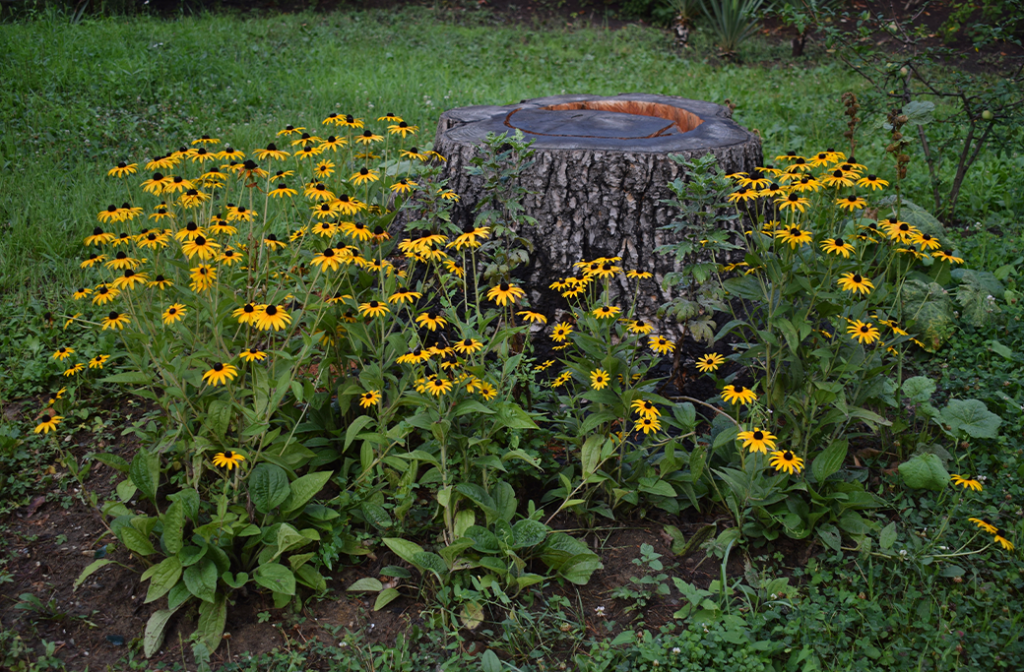
A flower bed can make the stump look like an intentional part of your front-yard landscaping.
Define a bed around the stump and choose plants that match the area’s sunlight, drainage, and available space. Depending on the location, that might include flowering annuals, low-growing perennials, ornamental grasses, or shade-tolerant plants.
Keep the plants around the stump, rather than piling soil directly over it. The stump will continue to decompose and change shape, so leave enough access to inspect it and adjust the bed later.
2. Arrange Container Plants Around It
Containers are one of the most flexible tree-stump cover ideas because they do not require digging through old roots.
Use several pots of different heights to soften the stump’s outline. Seasonal flowers can add color, while evergreen or foliage-focused plants provide a longer-lasting display.
Containers also make it easy to change the arrangement if the stump settles, sprouts, or deteriorates. Just avoid placing an extremely heavy planter on top of a stump unless you know the wood is solid and the surface is stable.
3. Turn a Sound Stump Into a Planter
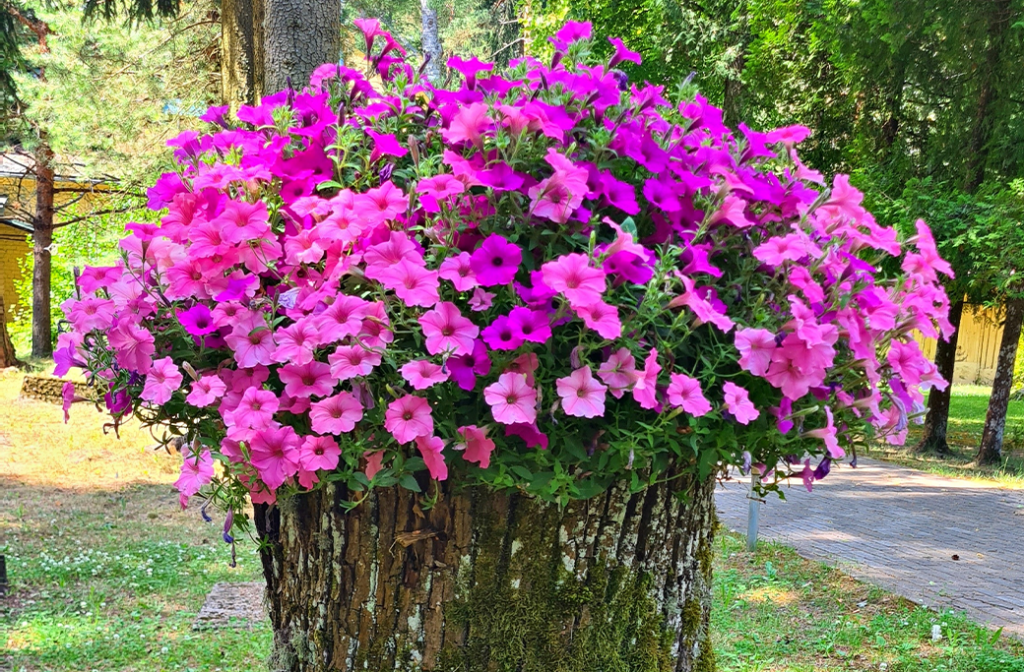
A broad, solid stump can sometimes be turned into a rustic planter. A shallow planting pocket may be created in the top, with adequate drainage so water does not remain trapped inside.
This approach works best when the stump is:
-
- Away from walkways and play areas
- Wide enough to hold a small planting pocket
- Still structurally solid
- Free of active nests or extensive decay
Keep in mind that cutting into the wood and keeping it moist can speed up decomposition. Treat the planter as a temporary garden feature rather than a permanent structure.
4. Place a Lightweight Planter on Top
If you like the planter look, but do not want to hollow out the stump, place a lightweight pot on top instead.
Choose a container with a wide, level base. Check it periodically to make sure the stump has not softened or shifted. Once the top becomes uneven, move the planter to the ground rather than trying to secure it to deteriorating wood.
This is particularly useful for a visible stump near the edge of a front-yard bed.
5. Add Lightweight Garden Art
A stump can serve as the background for a small piece of garden art, a solar lantern, or another lightweight decorative feature.
Keep the decoration proportional to the stump, and do not treat old wood as a permanent support for something fragile or heavy. A large birdbath or stone ornament could tip as the stump decays.
The safest approach is to arrange the feature beside the stump or use something light enough to relocate easily.
6. Build a Mulch Bed Around It
If flowers are not practical, create a defined mulch bed around the stump. This can reduce the awkward appearance of a stump sitting in the middle of a lawn and make mowing easier.
Spread mulch around the surrounding bed, but leave the top of the stump visible. Do not create a deep mound that buries the stump or hides holes, sprouts, insects, or fungal growth.
For help choosing an appropriate material, see what mulch works best around trees.
7. Create a Woodland-Style Garden
A stump can look surprisingly natural in a woodland-inspired planting area.
Use the stump as a visual anchor and arrange shade-tolerant plants, natural stones, leaf mulch, and small containers around it. This approach works especially well near mature trees or along a wooded property edge.
Select plants according to the actual light and soil conditions. Do not pack plants so closely that you can no longer see or inspect the stump.
8. Use a Low Decorative Screen
A short section of decorative fencing, open lattice, or a freestanding garden screen can reduce the stump’s visibility without attaching anything directly to it.
Choose an open design that allows air circulation and leaves room for inspection. The screen should not block a walkway or create a hidden tripping hazard.
Freestanding screening is usually easier to adjust than a structure anchored to wood that will continue to decay.
9. Surround It With Low-Growing Plants
Groundcovers and compact plants can soften the appearance of a low stump without completely concealing it.
Before planting, consider:
-
- The amount of sun the area receives
- Soil moisture and drainage
- Mature plant width
- The remaining root system
- How easily you will be able to maintain the bed
Avoid aggressive plants that may spread beyond the intended area or climb nearby living trees. Container-grown plants can be a safer alternative when you are uncertain about digging around remaining roots.
10. Make It an Intentional Natural Feature
Sometimes the simplest option is to stop trying to cover the stump completely.
A weathered stump can become part of a natural garden when paired with a clean border, a few well-placed plants, and an uncluttered layer of mulch. This is especially effective in informal or woodland-style landscapes.
A visible stump is also easier to monitor than one buried under soil or hidden beneath a permanent structure.
Stump-Hiding Ideas to Avoid
Not every creative-looking project is a practical one. Avoid using a stump in ways that create a maintenance or safety problem.
Do Not Use a Decaying Stump as Seating
A stump may look strong while decay is developing inside it. Do not use an old stump as a chair, table, play structure, or support for a heavy object unless its condition is known and it is located away from active areas.
Do Not Bury It Under a Deep Layer of Soil
Adding soil does not eliminate the stump. The wood will continue to decompose underground, potentially causing the surface to settle.
A shallow planting bed around the stump is different from building a mound directly over it.
Do Not Build a Permanent Patio Over It
Stumps and large roots lose volume as they decay. Pavers, edging, or other hardscape installed directly over that area may eventually settle or become uneven.
If you plan to build in the area, deal with the stump before construction begins.
Do Not Hide Signs of Decay or Pest Activity
Mushrooms, cavities, loose wood, insects, and hollow areas are reasons to inspect the stump rather than immediately covering it. These signs do not automatically mean there is an emergency, but they can affect whether the stump is suitable for decoration.
Should You Hide a Tree Stump or Grind It?
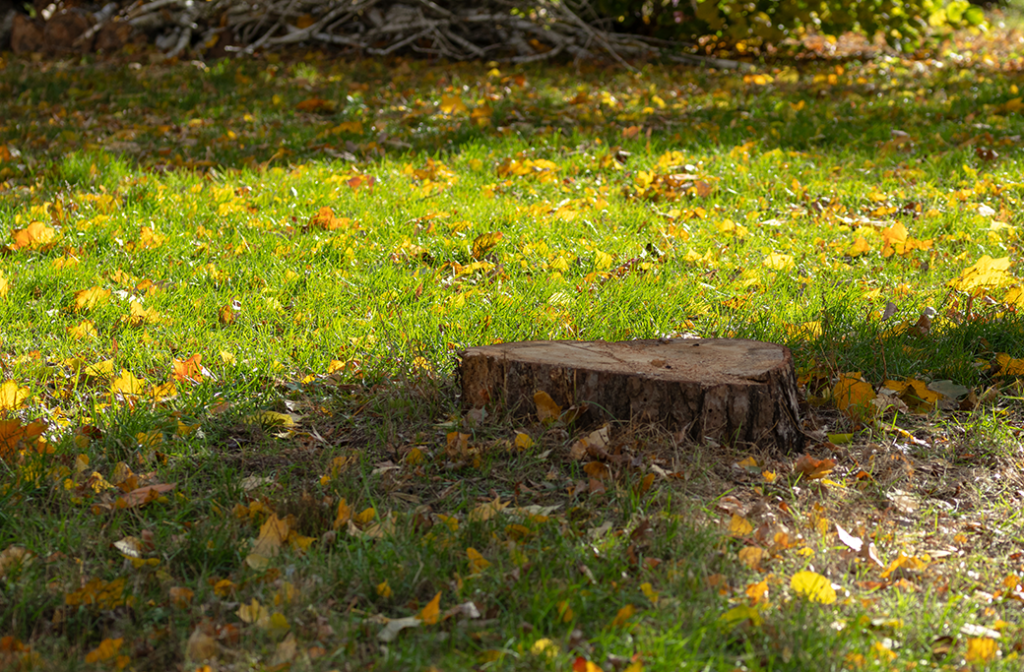
Hiding a stump makes the most sense when it is primarily a cosmetic issue. Grinding becomes more practical when the stump interferes with how you use or maintain the property.
| Hiding may be reasonable when… | Grinding may be better when… |
|---|---|
| The stump is in a low-traffic planting bed | The stump creates a tripping or mowing hazard |
| It does not interfere with lawn care | It sits in a walkway, play area, or frequently used lawn |
| The wood remains reasonably solid | The wood is soft, hollow, loose, or badly deteriorated |
| You do not plan to build or replant there soon | You want to install a patio, walkway, lawn, or new planting |
| Sprouting is limited or manageable | New shoots continue to grow from the stump or roots |
| It can remain visible enough to monitor | Landscaping would conceal insect, fungal, or decay activity |
| You are comfortable adjusting the bed as it decomposes |
North Carolina yards commonly contain termites and other organisms that break down dead wood. Finding termites outdoors in a stump does not by itself mean that a house is infested. NC State Extension notes that outdoor swarmers near a stump are not proof of a structural infestation, although wood near a home should still be monitored carefully.
Consider an evaluation when a stump is close to the house, heavily decayed, difficult to mow around, or interfering with a larger landscaping project.
Professional tree stump removal and grinding can provide a more usable surface when disguising the stump no longer solves the underlying problem.
What Happens as a Tree Stump Decays?
A stump does not remain unchanged. Over time, moisture, fungi, insects, and other organisms break down the wood. The rate depends on factors such as:
-
- Tree species
- Stump diameter
- Moisture
- Sun exposure
- Soil contact
- Whether the stump continues to sprout
- How much of the root system remains
As the wood loses strength, decorations may shift and soil around the stump may settle. Check the area periodically, especially after long periods of rain.
If the stump came from a tree that was dead or severely deteriorated, you may also find what happens when a dead tree is left standing helpful when evaluating other trees on the property.
Can You Plant a New Tree Where the Old Stump Was?
Planting in the exact location can be difficult even after the stump is ground. Large roots may remain underground, and wood chips mixed into the soil can affect soil structure and the establishment of a new tree.
When space allows, choose a nearby planting location that gives the new root system room to develop. Iowa State University Extension recommends moving a replacement tree away from the old planting site when possible because remaining roots, grinding debris, and the reason the original tree failed can all affect establishment.
Before selecting a replacement, review the principles of choosing the right tree for the right space.
Ready to Stop Landscaping Around the Stump?
Not every stump needs to be removed. But if yours keeps getting in the way, creates a tripping or mowing hazard, shows significant deterioration, or prevents you from using the space as planned, disguising it may only postpone the real solution.
Ask Shannon & Sons Tree Service to evaluate the stump and the surrounding area. We can help you determine whether it can reasonably remain or whether professional grinding will give you a safer, more useful space for your lawn and landscaping.